

One of the many allurements of private jet travel is the promise of a seamless, stress-free journey, often extending right to your baggage. Gone are the days of rigid weight restrictions, long check-in lines, and the anxiety of lost luggage that can plague commercial flights. However, while private jets offer significantly more flexibility, understanding the nuances of luggage allowances is still key to a truly smooth experience.
Unlike commercial airlines with their standardized and often restrictive policies, luggage capacity on a private jet is far more dynamic. It’s less about a one-size-fits-all rule and more about a personalized assessment influenced by several critical factors.
The Aircraft is King: Size Matters
The type of private jet you’re flying is, without a doubt, the most significant determinant of your baggage allowance. Just like cars, private jets come in various sizes, each with vastly different cargo capacities.
- Very Light Jets (VLJs) and Light Jets: Think Embraer Phenom 100, Cessna Citation M2, or HondaJet. These agile aircraft are perfect for short to medium-range flights and typically accommodate 4-7 passengers. Their luggage compartments, while more generous than a commercial overhead bin, are still compact. You’re generally looking at space for a few standard carry-on suitcases, soft duffel bags, and perhaps a set of golf clubs or skis, provided they can fit through the cargo door. Hard-sided luggage might be a tight squeeze, especially for multiple passengers.
- Midsize and Super-Midsize Jets: This category includes popular models like the Citation Latitude, Learjet 60XR, or Challenger 350. With seating for 7-10 passengers, these jets offer a substantial step up in luggage volume. You can typically expect to bring several large suitcases per passenger, along with additional items like golf clubs, skis, or even small musical instruments. The cargo hold is often accessible from the cabin in some models, adding to convenience.
- Heavy Jets and Ultra-Long-Range Jets: Gulfstream G650, Global 7500, Dassault Falcon 8X – these are the titans of private aviation. Designed for transatlantic journeys and larger groups (10-16+ passengers), they boast cavernous baggage compartments. You can generally bring multiple large suitcases per person, often without specific weight limits, along with an array of specialized equipment such as multiple sets of golf clubs, large ski bags, bicycles, and even dive gear. Some heavy jets have fully pressurized and heated baggage compartments, allowing for even more diverse cargo.
Passenger Load and Fuel Considerations
While the physical space of the aircraft’s baggage hold is important, it’s not the only factor. The number of passengers on board and the length of your flight also play a crucial role.
- Fewer Passengers, More Luggage: It’s simple arithmetic. If a light jet has a maximum payload (total weight of passengers, crew, and baggage) and you’re flying with only two people instead of its capacity of six, there’s more available weight for your luggage. This often means you can bring significantly more than if the jet were fully booked.
- Fuel vs. Luggage: Every aircraft has a maximum take-off weight. The heavier the fuel load required for a longer flight, the less weight is available for passengers and their belongings. For shorter hops, the fuel load is lighter, potentially freeing up more allowance for baggage. Your charter broker or flight operator will always calculate this meticulously to ensure safety and performance.
Beyond Suitcases: Special Items
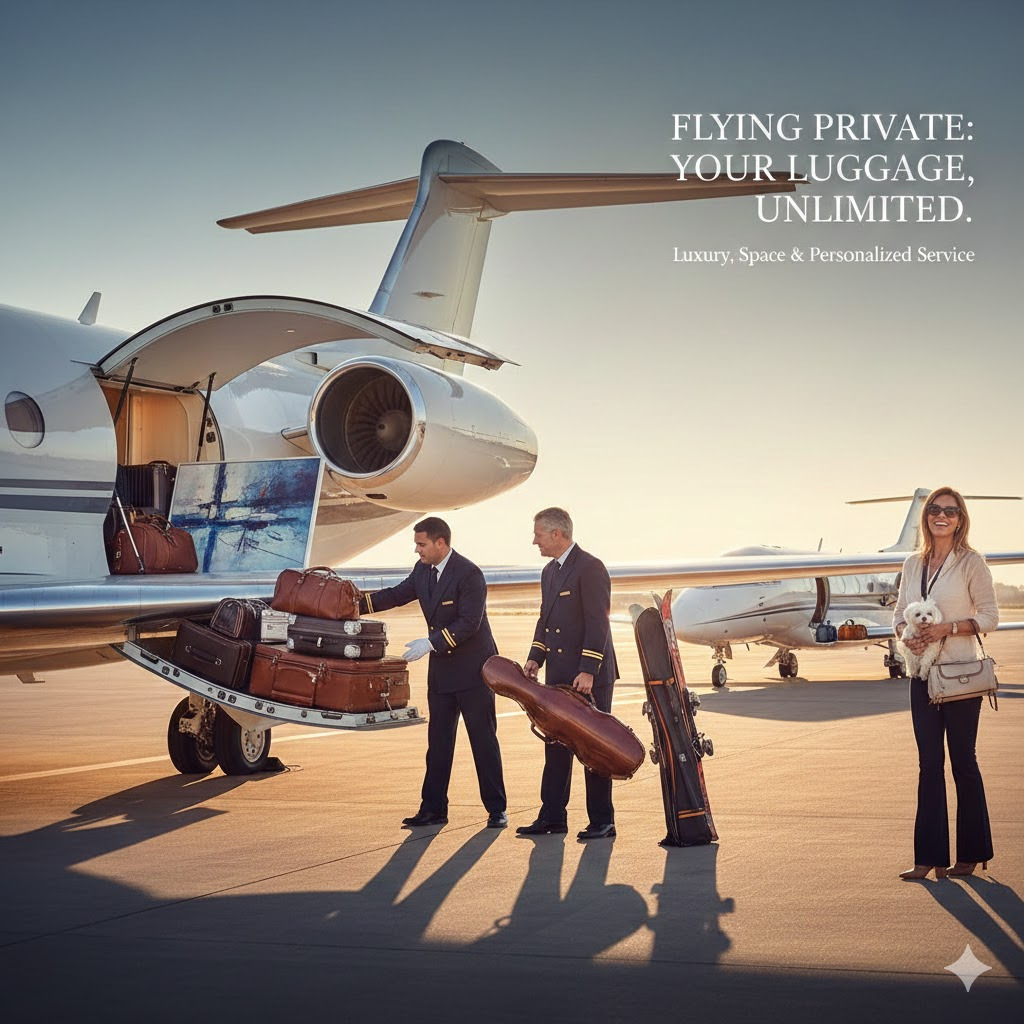
One of the great advantages of private travel is the ability to bring items that would be a nightmare on a commercial flight.
- Sports Equipment: Golf clubs, skis, snowboards, surfboards, and even bicycles can often be accommodated, especially on mid to heavy jets. Always declare these items in advance so the operator can confirm they fit and make necessary arrangements.
- Musical Instruments: From guitars to cellos, many instruments can travel with you, sometimes even secured in an empty seat, depending on their size and the aircraft type.
- Pet Travel: Your furry companions are often welcome in the cabin, eliminating the stress of cargo holds. Their carrier might count as a piece of luggage, and specific regulations apply, so always discuss this upfront.
- Unusual or Oversized Items: Need to transport a piece of art, a specialized camera rig, or even certain medical equipment? Private jet operators are generally very accommodating, but advance notice is essential for planning and loading.
The Golden Rule: Communicate with Your Charter Provider
The single most important piece of advice regarding private jet luggage is to always communicate your baggage needs in detail to your private jet charter provider or flight operator well in advance.
- Be Specific: Don’t just say “a few bags.” Specify the number of bags, their approximate size (carry-on, medium, large), and if they are hard-sided or soft-sided.
- Declare Special Items: Crucially, inform them of any oversized, fragile, or unusual items like golf clubs, skis, instrument cases, or car seats.
- Provide Dimensions and Weight (if known): For particularly large or heavy items, providing dimensions and weight can help the operator determine the best aircraft and loading plan.
Your charter provider will then be able to:
- Recommend the Right Aircraft: Based on your passenger count and luggage, they can advise on the most suitable and comfortable jet for your trip.
- Confirm Capacity: They can confirm precisely how much your chosen aircraft can safely carry.
- Plan Loading: They will coordinate with the ground crew to ensure efficient and safe loading of all your belongings.
What About Weight Limits?
While private jets offer significantly more leeway than commercial flights, weight limits still exist. These are crucial for the safe operation of the aircraft. However, for the average private traveler, these limits are rarely a concern unless you’re transporting unusually heavy cargo or flying a fully-loaded smaller jet on a long journey.
The focus is generally more on the volume and dimensions of your luggage – ensuring it physically fits into the cargo hold and through the access doors – rather than strict per-bag weight limits.
Conclusion
Flying private liberates you from many of the hassles associated with air travel, and luggage is a prime example. While you won’t typically face the same stringent restrictions as on a commercial flight, a little planning and clear communication with your charter provider will ensure your journey is as smooth and baggage-free as possible. So go ahead, pack that extra outfit, bring your beloved golf clubs, and enjoy the unparalleled convenience of private jet travel, where your luggage genuinely takes a backseat to your comfort.